The 30,000-foot view
A blind poet dictates the story of everything: the war in Heaven, the creation of the world, the temptation and fall of Adam and Eve, and the promise of eventual redemption. Satan, the most charismatic figure in English poetry, rebels against God, is cast into Hell, and takes his revenge by corrupting humanity. Milton's ambition was to 'justify the ways of God to men' -- but his Satan is so magnificently defiant that readers from Blake onward have wondered whose side the poet was really on.
Milton began Paradise Lost after the collapse of everything he had fought for. The Puritan revolution had failed, the monarchy was restored in 1660, and Milton -- blind, politically disgraced, briefly imprisoned -- turned from pamphleteering to epic poetry. The poem is simultaneously a theodicy, a political allegory of failed revolution, and the greatest sustained achievement in English blank verse. Written in the shadow of defeat, it asks the most fundamental questions: why do the righteous suffer? Is obedience freedom or servitude? Can humanity recover from catastrophic error?
Paradise Lost invented the literary Satan, reshaped English poetry, and posed questions about free will, authority, and rebellion that remain unresolved. It gave the Romantics their hero, feminists their quarry, and every subsequent epic its impossible standard. No poem in English has been more argued over, more imitated, or more consequential. To read it is to encounter the architecture of Western moral imagination at its most ambitious and most conflicted.
Critics, authors, and cultural figures on Paradise Lost
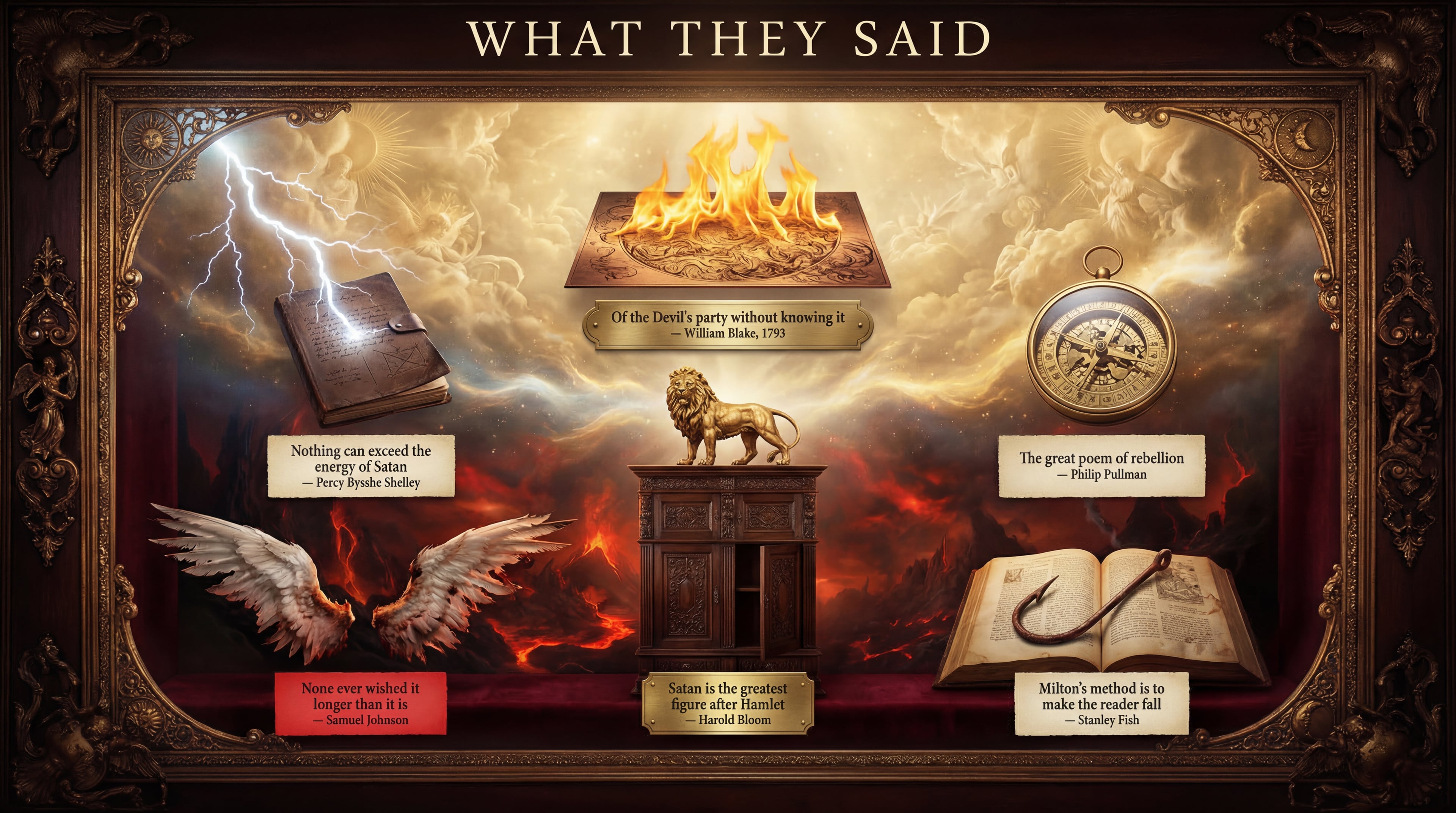
The reason Milton wrote in fetters when he wrote of Angels & God, and at liberty when of Devils & Hell, is because he was a true Poet and of the Devil's party without knowing it.
Nothing can exceed the energy and magnificence of the character of Satan as expressed in Paradise Lost. Milton's Devil as a moral being is as far superior to his God, as one who perseveres in some purpose which he has conceived to be excellent in spite of adversity and torture.
Paradise Lost is one of the books which the reader admires and lays down, and forgets to take up again. None ever wished it longer than it is.
It is not that he is a liar, but that he is a fool. Satan is the best-drawn character in the poem precisely because Milton understood the psychology of temptation from the inside.
Milton is the first of the masculinists. He deals in horror and sublimity, not in the human heart. But one cannot dismiss Milton. One turns from him to consider how great a poet he was.
Milton writes English like a dead language. The emphasis is on the sound, not the vision, upon the word, not the idea. The syntax is determined by the musical significance.
Satan is the greatest figure in Western literature after Hamlet. Milton's Satan inaugurates the literary Sublime, the tradition of heroic overreaching that runs from Ahab to Kurtz.
The poem's purpose is to educate the reader, to make him a better reader -- and a better man. Milton's method is to re-create in the mind of the reader the drama of the Fall, to make him fall, and then to force him to acknowledge his complicity.
Of all the books I have read, Paradise Lost is the one I keep coming back to. It is the great poem of rebellion, of the refusal to submit to tyranny. Blake was right: Milton was of the Devil's party.
I thought of the promise of virtues which he had displayed on the opening of his existence, and the subsequent blight of all kindly feeling by the loathing and scorn which his protectors had manifested towards him.
See how Paradise Lost connects to Ulysses, Hamlet, The Waste Land, Inferno, and the Gita
Each layer reveals a different dimension of Milton’s epic
Theological, classical, and linguistic vocabulary in Milton’s epic
References to Homer, Virgil, Ovid, Dante, Spenser, and the classical tradition
Christian doctrine: free will, predestination, the fortunate fall, Arianism
The vertical cosmos: Heaven, Chaos, Eden, Hell — and Satan’s flight between them
Psychological states: Satan’s pride, Eve’s curiosity, Adam’s love, God’s justice
Epic similes, Latinate syntax, enjambment, invocations, catalogues
Passages referenced in scholarly debates and critical discussions
Biblical and classical sources: Genesis, Isaiah, Revelation, the Aeneid
Connections to the Odyssey, Inferno, Hamlet, and other works in the Universe
Centuries of critical argument over Milton’s intentions and meaning
Satan dominates the first two books with magnificent rhetoric, Promethean defiance, and tragic grandeur. Since Blake declared that Milton was 'of the ...
Milton's God speaks in Book 3 with a legalistic tone that many readers find cold, defensive, and unsympathetic compared to Satan's passionate rhetoric...
Eve is the most contested character in Paradise Lost. She proposes the separation that leads to the Fall, eats the fruit first, and is told by both Ad...
Background shifts as you traverse Heaven, Chaos, Eden, Hell, and Earth
Track Satan’s flight from the burning lake through Chaos to Eden and back
Free will, predestination, the fortunate fall, Arianism — annotated in the text
Epic similes, Latinate syntax, enjambment, invocations, and Miltonic grand style
Biblical and classical sources: Genesis, Isaiah, Revelation, the Aeneid, Ovid
3D interactive graph of characters, places, theological concepts, and cosmic realms
Navigate the most famous lines — from "Better to reign in Hell" to the final departure
Scholarly companions to the greatest works of literature
Bloomsday in Dublin
5 acts, 20 scenes
434 lines of modernism
34 cantos through 9 circles
One day in London, June 1923
18 chapters, three yoga paths
24 books, the voyage home
12 books spanning the cosmos
“They hand in hand, with wandering steps and slow, / Through Eden took their solitary way.”
Book 12, Lines 648–649