The 30,000-foot view
On a single June day in 1923, Clarissa Dalloway walks through London preparing for her party while Septimus Warren Smith, a shell-shocked veteran, walks the same streets toward his death. Woolf tunnels into their minds and the minds of those around them — Peter Walsh returning from India, Richard with his roses, young Elizabeth on the bus — creating a web of consciousness that connects private memory to public spectacle, the personal past to the historical present.
Written in the aftermath of the Great War, as London rebuilt itself and the British class system strained under the weight of what it had survived. Woolf was developing her 'tunnelling' technique — digging caves behind her characters, connecting the present moment to deep reservoirs of memory. The novel was published by the Woolfs' own Hogarth Press, giving Virginia complete creative freedom over a book that challenged every convention of the English novel.
Mrs Dalloway proved that the inner life of a woman preparing a party could sustain the weight of a novel — that consciousness itself, with its constant shuttling between past and present, is the real drama. Its twin-protagonist structure (Clarissa and Septimus never meet) pioneered a form of narrative doubling that influenced generations of writers. Woolf's London is as precisely mapped as Joyce's Dublin, but where Joyce catalogues, Woolf luminously inhabits.
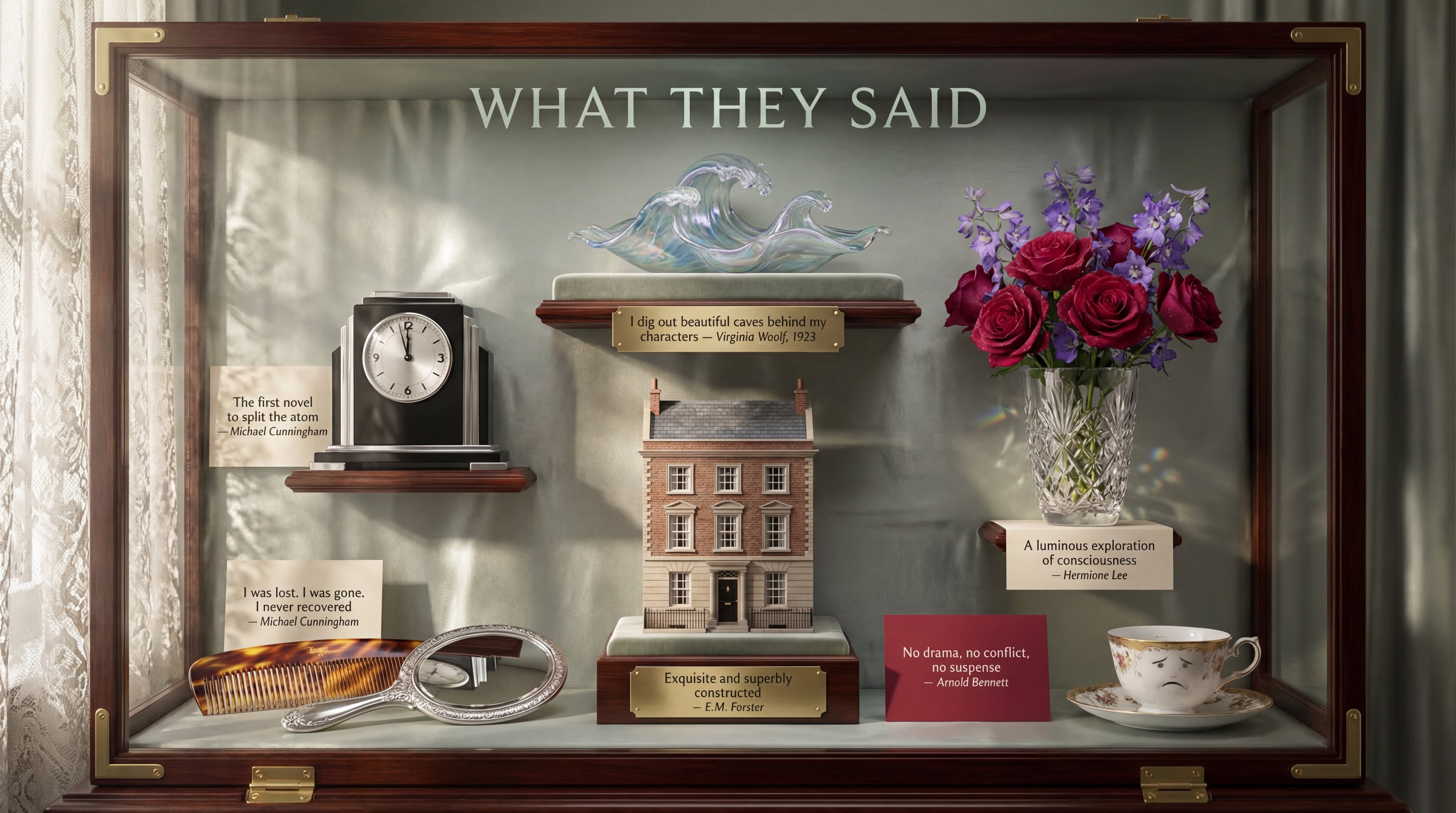
Critics, authors, and cultural figures on Mrs Dalloway
It is exquisite and superbly constructed — the most beautiful novel Mrs Woolf has written.
Mrs Dalloway was, as far as I'm concerned, the first novel to split the atom — to reveal the microscopic life that teems within a single moment.
I dig out beautiful caves behind my characters. The idea is that the caves shall connect.
A luminous exploration of consciousness that is also, quietly, one of the great political novels of the twentieth century.
There is no moral, no philosophy, nor has it what is usually understood by 'Form.' It is all rhythm — the rise and fall of consciousness through a single day.
I was lost. I was gone. I never recovered. It's still the book that makes me want to write.
Woolf rewrites the novel of manners as a novel of mind — the drawing room is now inside the skull.
The most political of Woolf's novels — a critique of Empire, class, and the medical establishment hidden inside a day of walking and thinking.
Woolf's struggle with feminism and the theory of androgyny — expressed through Clarissa's dual nature as hostess and rebel.
The absence of a compelling story. I could not finish it. There is no drama, no conflict, no suspense.
See how Mrs Dalloway connects to Ulysses, Hamlet, The Waste Land, Inferno, and the Gita
Toggle annotation layers to read Woolf from different angles
Whose mind we inhabit — track shifts between Clarissa, Septimus, Peter, and more
Big Ben strikes, St Margaret’s, temporal markers — clock time vs inner time
Real London locations: Bond Street, Regent’s Park, Westminster, Harley Street
Tunnelling: present (June 1923) → past (Bourton summers, the war, India)
Class, gender, Empire, Proportion & Conversion, institutional power
Shakespeare (Cymbeline, Othello), Shelley, literary echoes
Passages cited in major scholarly debates — linked to positions and evidence
Clarissa↔Septimus parallels, shared responses, mirror structure
A century of argument, still unresolved
Follow whose mind we inhabit at every moment — Clarissa, Septimus, Peter, and seven more voices
Every location mapped: Bond Street to Regent’s Park, Westminster to Harley Street
Track the tunnelling process: when the narrative plunges from June 1923 into Bourton summers or the war
9 motif categories: time/clocks, flowers, water/waves, memory, death, class, war, London, identity
Traverse the novel’s day from morning walk to midnight party in a visual timeline
A clock-face visualization showing whose mind we inhabit at each hour of the day
Navigate 10 famous passages with narrative context — enter the novel at its most celebrated moments
One day, one city, twelve minds
Scholarly companions to the greatest works of literature
Bloomsday in Dublin
5 acts, 20 scenes
434 lines of modernism
34 cantos through 9 circles
18 chapters, three yoga paths
24 books, the voyage home
12 books spanning the cosmos
“Fear no more the heat o’ the sun”
— Virginia Woolf, Mrs Dalloway (1925)
A scholarly companion to Woolf's modernist masterpiece — centenary edition, 1925–2025